

There is an unwritten law in software engineering: never deploy on a Friday. Not because the code is worse on Fridays, but because nobody wants to spend their weekend finding out that it is broken. The entire ritual – the deploy freezes, the nervous Slack messages, the ‘let’s just push it to Monday’ – is a symptom of teams that don’t trust their testing. In other words, when Quality Assurance (QA) is slow and unreliable, it slows down product velocity. It grinds the business to a halt.
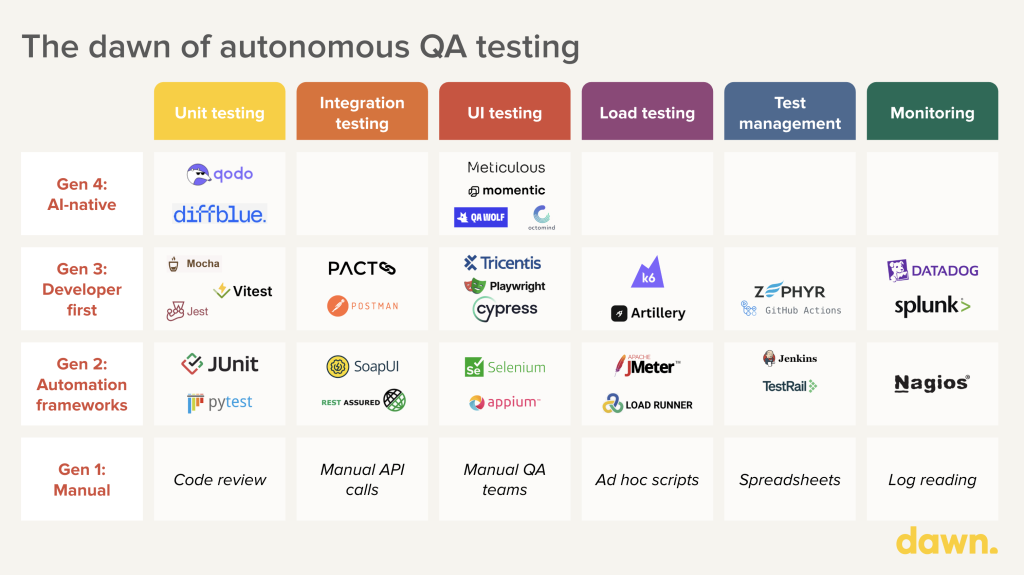
That’s why we’ve seen continued investment in new QA solutions over the years. From manual QA testing (Gen 1) with dedicated departments, hand-run scripts, waterfall releases, to the first automation frameworks (Gen 2, like Selenium, JUnit, pytest) which allowed developers to write their own tests and run them on every commit, and then truly developer-first tools (Gen 3, like Cypress, Playwright, k6). Now, we’re seeing another step change into autonomous testing (Gen 4), with tools that generate, maintain, and self-heal tests. We need it more than ever since the pace of code generation is only increasing, and multiple reports indicating that >40% of AI generated code contains issues or vulnerabilities.
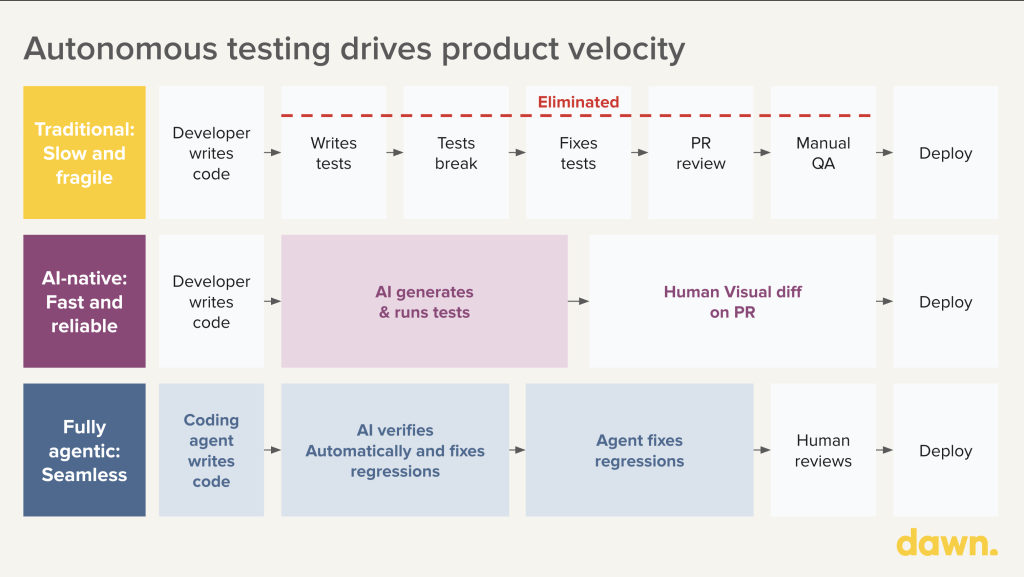
The impact can be enormous. We’ve heard from engineers in major tech companies that verification was almost entirely manual just a few years ago – handled by QA teams in a different timezone. This limited them to one deployment per day. After investing in AI-native testing, teams can ship 2x faster, and improve customer satisfaction. One technical leader we spoke to placed their autonomous QA tool alongside Claude and Cursor in importance.
“People are able to ship faster because they are more confident. They’re just going faster in iterations and merging to main quickly.” — Engineering Manager, leading tech company
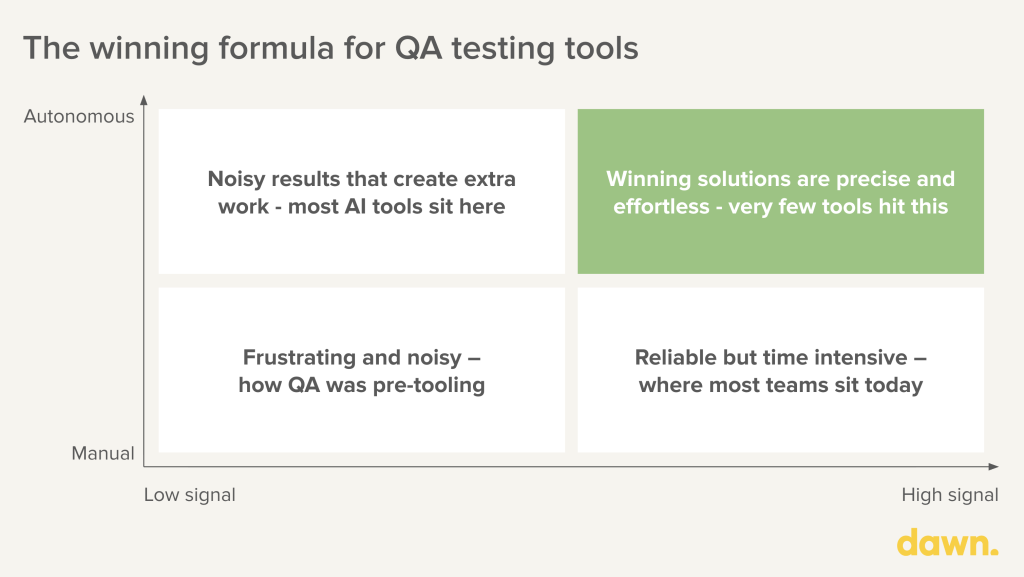
Engineers care about freeing their attention. New QA tools coming into the market need to prove themselves across four key dimensions to truly drive the best developer experience and adoption at scale.
- Autonomy. First of all, engineers want to be able to spend as little time as possible writing and maintaining testing. When a tool can automate test writing and execution, engineering managers have told us that when a tool can do truly automated testing, that means that no prompting is required, the surface area it can covers usually improves from 20-25% to 95%.
- Signal quality. One of the major challenges with QA testing is false positives. Engineers don’t want to waste their time, and low precision kills adoption. An engineering leader told us that “Quality of signals and noisiness—these two are very important. If it reduces incidents significantly, it’s a good tool. It’s easy to measure.”
- Workflow adaptability. Developers want agents to fit into their workflow. As agentic coding takes hold, QA must plug into Claude Code and Cursor directly. The best tools will not only “shift left” to catch bugs ahead of deployment, but also “shift right” using production signals like error traces, user behaviour, and incident patterns to continuously generate and prioritise the tests that matter most.
- Incident prevention. Ultimately, the bottom line is to shift from “find bugs” to “stop incidents.” We hear teams tell us that it is ultimately simple: “the product needs to be beautiful and working great at all times”. If testing prevents issues from arising, then teams will be happy.
Whilst the opportunity ahead is huge, it will be fiercely competitive. Winning relies on driving a rapid flywheel of customer love and community-led adoption.
- Customer love is driven by fast impact. The best products are onboarding in two to three weeks with immediate results. This creates a clear “wow” moment, and allows them to shift fast to selling outcomes rather than seats: driving product velocity and freeing a whole team of manual testers ($100-200k each) within a few months.
- Go-to-market is most efficient when you crack the developer-first motion. Just as Playwright beat Selenium through word-of-mouth, not RFPs, autonomous QA is following the same playbook. Engineers trust engineers over sales people, therefore open-source components, transparent benchmarks, and real community presence support fast growth.
Ultimately, engineers hate maintaining tests, incumbent tools are brittle, and agentic coding accelerates the urgency. The tools winning engineers will love are fully autonomous, high precision, deeply embedded in agentic workflows, and focused enough to earn trust before expanding. We’re excited to back the next generational companies in this space.
If you are building in QA testing, get in touch with us at henry@dawncapital.com, romeo@dawncapital.com, and andrea@dawncapital.com