

As software and technology have eaten industry after industry, government has often remained a bastion of archaic inefficiency, legacy systems, and technological stagnation. Finally, national operating systems are being rewritten. But this isn’t a classic B2B venture.
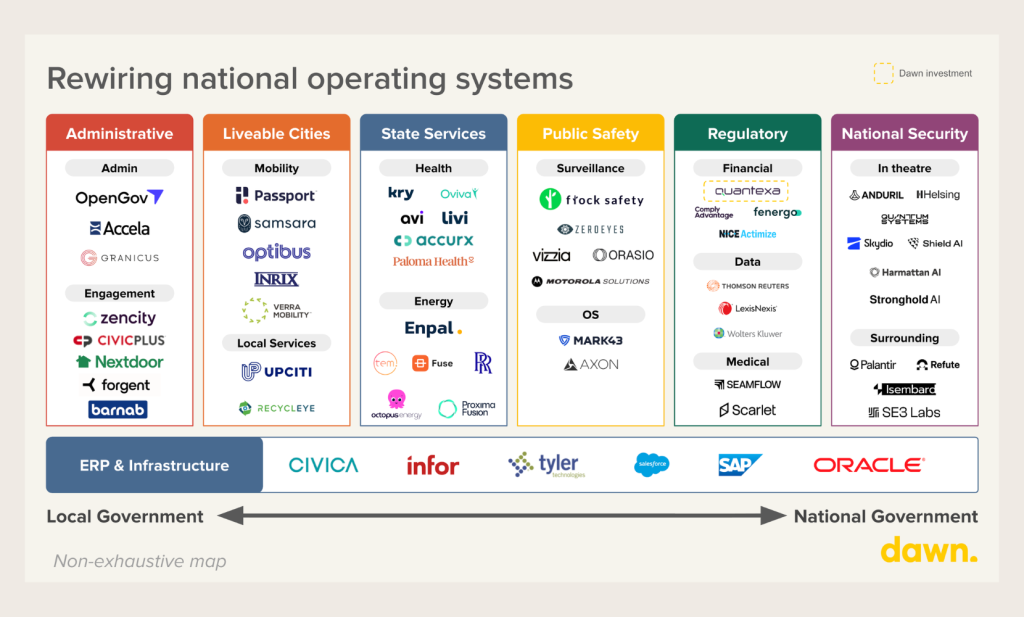
The challenge in government
For millennia, governments have sat at the heart of our civilisations. They have organised security, built infrastructure, protected our health, and shaped our national identity. The inspiration for the American Apollo program, the pride of Britain’s National Health Service, the marvel of the Dutch Delta Works. These all stand as proof of what the Government can achieve at its best.
But today, amid intensifying geopolitical competition and rising public expectations, those same institutions can feel stuck in the past. Citizens compare sluggish public services to the dazzling pace of private-sector innovation, and the contrast is stark. With legacy systems, outdated processes, and an inability to keep up, the machinery of many a government worldwide is no longer fit for purpose.
Governments have been slow to adopt technology, largely due to slow procurement cycles, complex stakeholder structures, and a lack of urgency to drive efficiency. The system is optimised not for buying software, but instead opting for big bespoke projects and services-heavy delivery. However, the balance is changing. In a world that is deglobalising, we are increasingly looking to build national champions. The role of governments is critical in this process, and it starts with modernising themselves.
The drivers of change
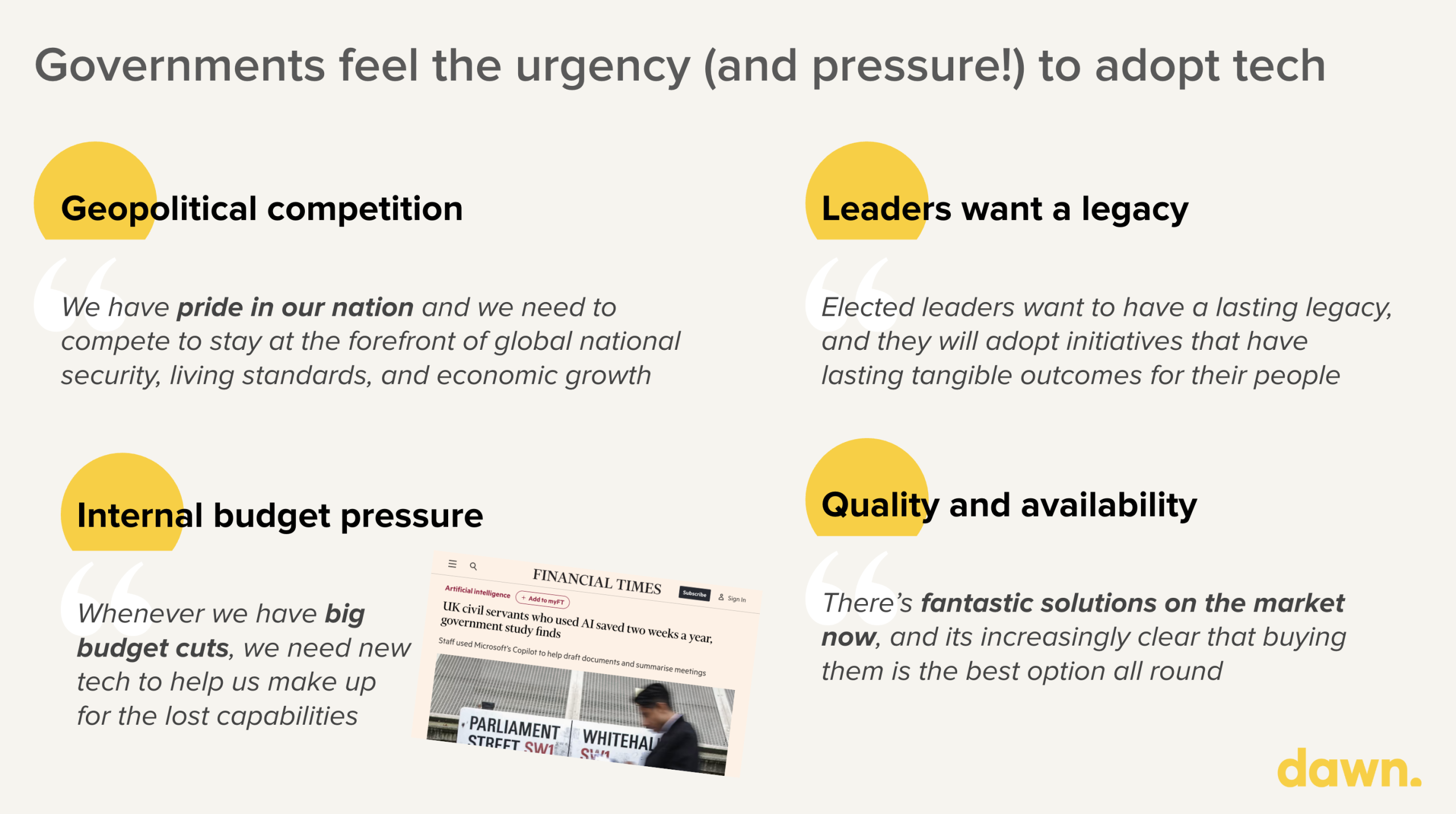
Governments now feel the urgency and pressure to adopt third-party solutions. If they’re not able to modernise internally – or with expensive consulting projects – they need to buy from the best. Private tech scale-ups are showing what is possible. Solutions such as Flock Safety have scaled to a $7.5bn valuation, selling into local policing budgets, and Passport has raised over $200m to build better local parking services. In national security, Palantir have carved out an enormous market for themselves with a $400b+ public market cap. Both local and central government procurement is now driving multi-billion-dollar technology outcomes.
The key drivers of change include competition, availability, and pragmatism:
- Geopolitical competition: Global events intensify competition, both on the battlefield and in local economies. To compete, national and local governments need to pursue the best solutions.
- Quality and availability: The best solutions are being built externally, and it becomes a no-brainer to buy rather than build. Governments are swallowing their pride and procuring externally to access the best innovation sooner.
- Internal budget pressure: Departments are being asked to do more with less; software that substitutes or augments labour is now a credible answer. For example, in local council budgets, personnel spend dwarfs tech, creating substitution potential if you tie software to outcomes.
- Leaders want a legacy: Elected leaders want measurable progress on headline priorities, and are increasingly pragmatic, seeing tech as a solution to a business problem, not a theatre of innovation.
Burning priorities
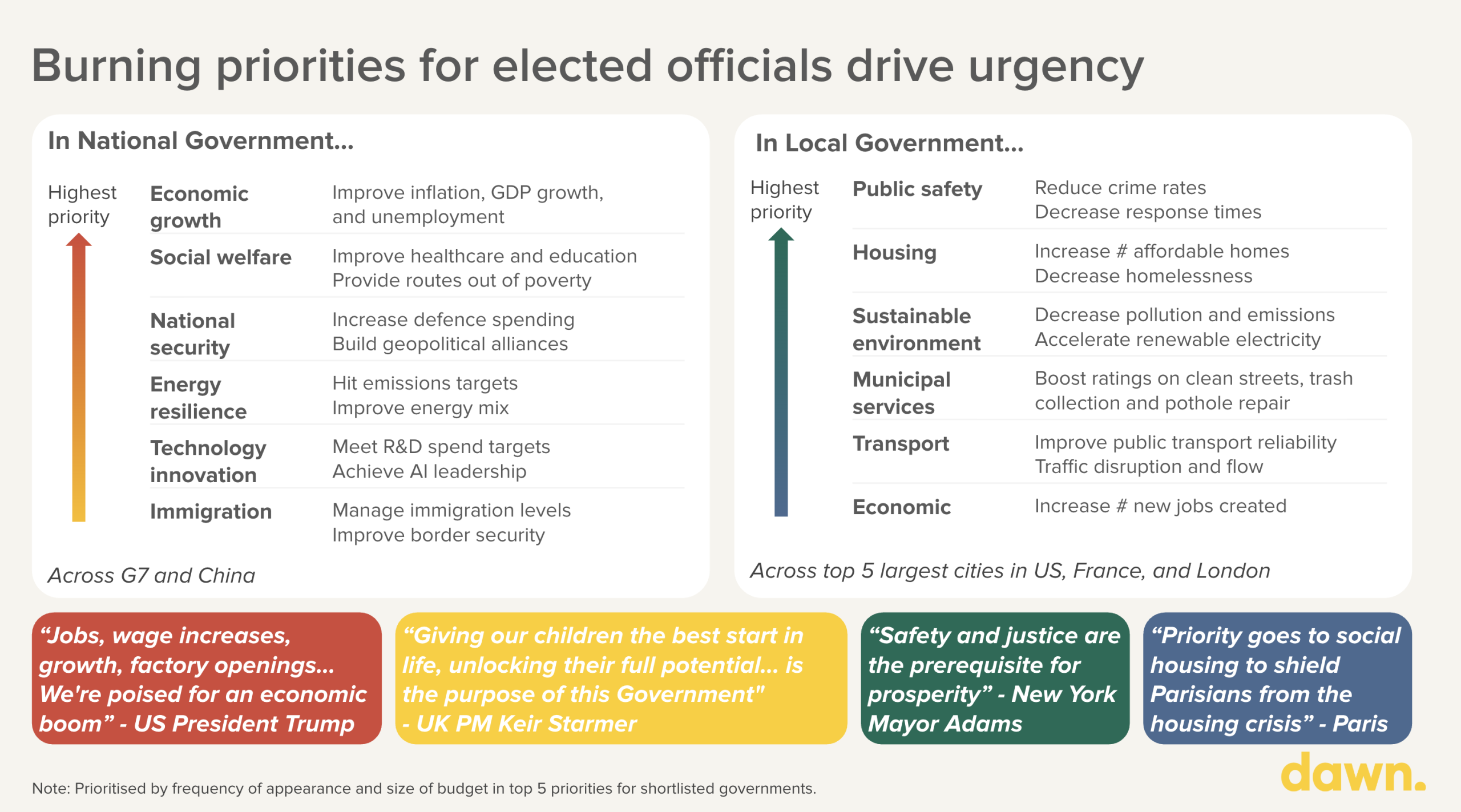
Governments are facing several burning priorities. After sifting through thousands of speeches and publications from major national and local governments, we’ve identified a set of critical themes true across governments. Those seeing the biggest impact from high-growth tech include:
- National security: A top priority for governments worldwide. A realisation that standards are falling short after years of underinvestment is driving a sharp increase in budgets, with scope including defence forces, critical infrastructure resilience, and cyber security. New tech players are emerging across the core chain of “Detect, Decide, Engage” and across enablers such as logistics and manufacturing.
- Public safety: At the local level, the top stated priority for local governments is consistently public safety. The first generation of software provided management systems for policing, followed by a new generation of remote surveillance solutions. The next generation includes the application of increasingly advanced intelligence.
- Health systems: Across Western nations, governments are grappling with health systems struggling to keep up with the increasing demand from ageing populations. We have seen a range of private companies driving positive impact, from simple messaging and communication tools to tech-first primary and secondary care clinics that offer lower costs and higher quality of care than existing public services.
- Energy resilience: The cost, security, and emissions of energy are critical issues for the government. We see innovation across multiple levels of the value chain that supports resilience, including new forms of energy generation, improvements in transaction layers, and more efficient use.
- Local services: Communities have been supported by new technology solutions for administration and citizen engagement, improving the relationship between citizens and the bureaucracy. We’ve also seen remote monitoring proving a key enabler to data-driven smart cities, with significant potential yet to be realised.
Beyond headline priorities, governments consistently prioritise driving efficiency to enable balanced budgets and operating with transparency and healthy public engagement. Core systems of record will continue to evolve to support greater automation and operational intelligence.
How to build a giant B2G business
Building a wildly successful B2G business is not typically the same as building a B2B business. Whereas incentives are clear-cut in a business context – driving revenue or cost efficiency – they aren’t always as straightforward in government. There are large pools of inefficient spend, budget decision-making is not always transparent, and the civil service workers aren’t necessarily directly incentivised for driving change.
We see four key drivers of spending within government:
- Existing budgets: Spending is likely to reflect that of past budget cycles unless a compelling case is made for change. Reallocation requires a credible, political story and significant stakeholder backing. Vendors can expect sticky contracts once they are in.
- Public narratives: Decisions are often shaped by public scrutiny and election cycles; “proof” means visible change to citizens and media, not necessarily performance against business indicators. New projects led by recently elected leaders are rare opportunities to drive change quickly and efficiently at scale.
- Procurement friction: Procurement cycles for meaningful spending can face many steps, hurdles, reviews, and committees before approval. Only exceptional priorities pushed through by the most senior government leaders can shortcut this.
- Localisation: Local dynamics are also important, with governments operating differently across geographies. For example, US government entities are run like businesses – from local councils through to national government, they are typically measuring local revenue and cost to ensure balanced budgets. This means spending decisions are more distributed. On the other hand, European governments often focus more on spending allocated budgets, and decision-making is concentrated in the hands of leaders.
Winning go-to-market strategies in the public sector, therefore, require tailored approaches:
- The local government can be compared to SMB sales, but is often strongly influenced by neighbouring counties and municipalities. We’ve seen GTM plays win by creating successful domino effects across regions. This starts with a close partnership with chiefs and elected officials, offering not just a technology solution but also a guarantee of ROI through experienced deployment specialists. Then it is critical to build advocacy at all levels, from the lowest officers to the mayor, and ultimately, the public. Actively driving media and public visibility of success stories has a strong signalling effect, driving word-of-mouth referrals.
- The national government is closer to an enterprise motion. Proving credibility early is critical; this can be achieved by aligning with senior leaders and generating cross-government pull. Stakeholder alignment is a key challenge that must be addressed by appointing a clear internal champion and leader for the initiative to drive rapid execution without excessive red tape. Finally, creating public visibility remains essential through clear KPIs communicated through speeches and departmental strategies.
What excites us at Dawn
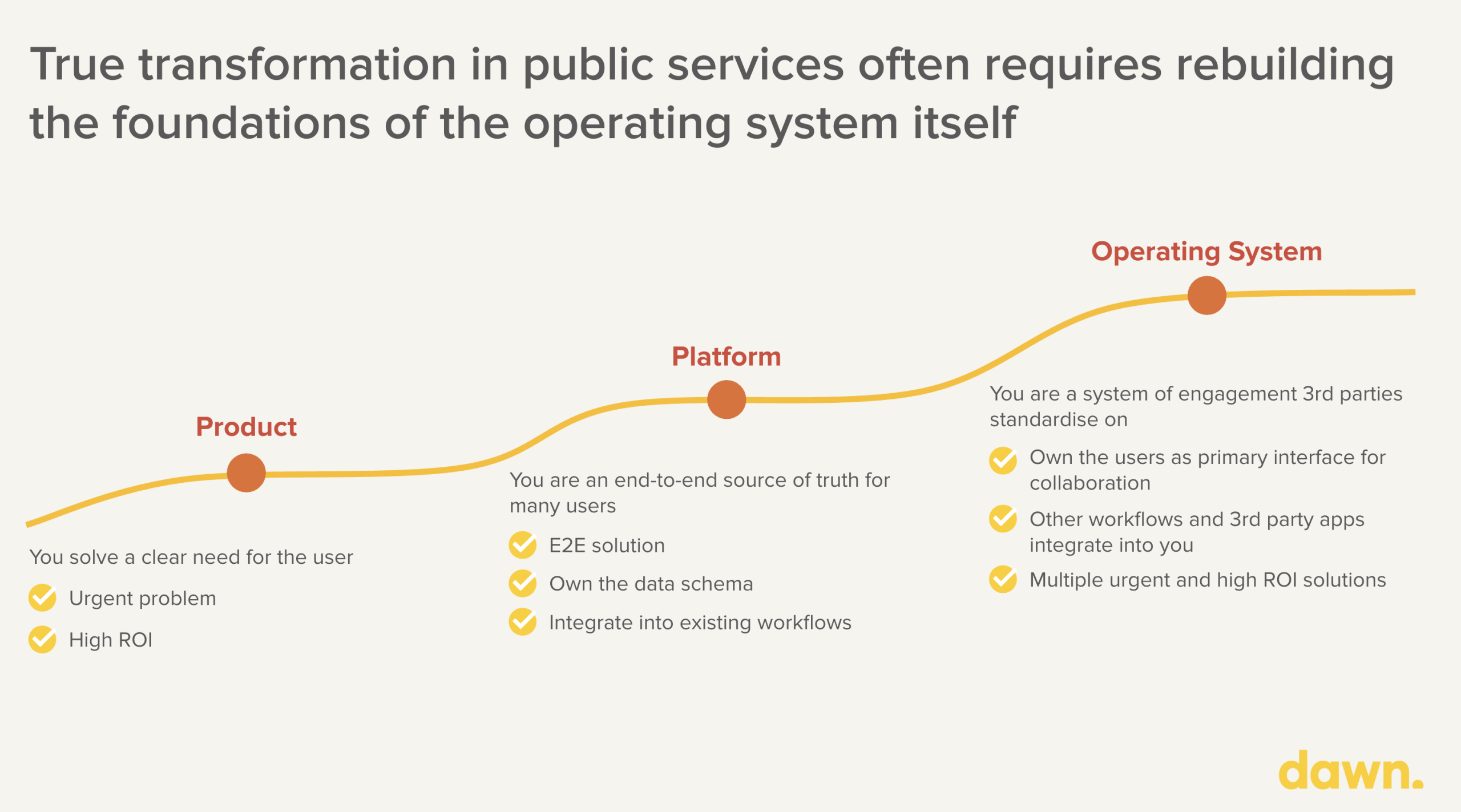
The ultimate opportunity is to redefine the standard of public service, as OpenGov has done for public administration, Anduril for defence manufacturing, and Flock Safety for crime reduction. There is now a proven path for building not just technology platforms that sell into governments, but operating systems which our nations depend on. They become the system of engagement that third parties standardise on and raise the bar for what we expect.
When businesses are selling B2G, we typically look for three signals before leaning in, which together tell us whether a business is set to build a massive solution serving government:
1. Burning problem: A top-three priority for a senior budget holder in local or central government (e.g., agency head, mayor, minister).
2. Tangible payback: A tangible use case that pays back department-level ROI quickly.
3. Category ownership: A credible path to own a departmental KPI and set a fundamental new standard – from a wedge product to an operating system which other products will standardise on.
Given a broadly low technology maturity across our governments, we believe generational opportunities exist across several layers of government. New operating systems are set to win and rewire the heart of our nations. Never has software had a grander or more patriotic ambition.
Please do get in touch with us at evgenia@dawncapital.com or andrea@dawncapital.com